
European Union and the Schengen Area: What’s the Difference?
Introduction
Travelers often use the terms “European Union” and “Schengen Area” interchangeably. However, they are not the same.
While most Schengen countries are also members of the European Union, the two frameworks serve different purposes.
The 90/180 day rule applies to the Schengen Area as a whole — not to the European Union collectively.
Before planning multi-country travel in Europe, it is essential to verify which countries participate in Schengen.
You can always calculate your permitted stay using the
Schengen Calculator – 90/180 Day Rule Planner
What Is the European Union?
The European Union (EU) is a political and economic union of 27 European countries.
It promotes economic integration, regulatory cooperation, and shared legislation among its member states.
However, EU membership does not automatically mean participation in the Schengen border-free system.
What Is the Schengen Area?
The Schengen Area is a zone where internal border controls between participating countries have been abolished.
Travelers can move between Schengen countries without passport checks at internal borders.
The Schengen framework establishes:
- Removal of internal border controls
- Common short-stay visa rules
- Coordinated external border policies
The 90/180 day rule is applied collectively across all Schengen member states.
EU and/or Schengen Countries Overview
|
Country |
EU Member |
Schengen Member |
|---|---|---|
|
Austria |
✓ |
✓ |
|
Belgium |
✓ |
✓ |
|
Bulgaria |
✓ |
✓ |
|
Croatia |
✓ |
✓ |
|
Cyprus |
✓ |
|
|
Czech Republic |
✓ |
✓ |
|
Denmark |
✓ |
✓ |
|
Estonia |
✓ |
✓ |
|
Finland |
✓ |
✓ |
|
France |
✓ |
✓ |
|
Germany |
✓ |
✓ |
|
Greece |
✓ |
✓ |
|
Hungary |
✓ |
✓ |
|
Ireland |
✓ |
|
|
Italy |
✓ |
✓ |
|
Latvia |
✓ |
✓ |
|
Lithuania |
✓ |
✓ |
|
Luxembourg |
✓ |
✓ |
|
Malta |
✓ |
✓ |
|
Netherlands |
✓ |
✓ |
|
Poland |
✓ |
✓ |
|
Portugal |
✓ |
✓ |
|
Romania |
✓ |
✓ |
|
Slovakia |
✓ |
✓ |
|
Slovenia |
✓ |
✓ |
|
Spain |
✓ |
✓ |
|
Sweden |
✓ |
✓ |
|
Iceland |
✓ |
|
|
Norway |
✓ |
|
|
Switzerland |
✓ |
|
|
Liechtenstein |
✓ |
|
|
Turkey |
||
|
United Kingdom |
||
|
Albania |
||
|
Serbia |
||
|
Montenegro |
||
|
North Macedonia |
||
|
Bosnia and Herzegovina |
Are All EU Countries in Schengen?
No.
While most EU member states participate in the Schengen Area, there are exceptions.
Ireland and Cyprus are EU members but do not fully participate in Schengen.
Are All Schengen Countries Members of the EU?
No.
Several Schengen countries are not members of the European Union.
These include:
- Iceland
- Norway
- Switzerland
- Liechtenstein
They participate in Schengen’s common visa and border framework but are not EU member states.
Why This Difference Matters for Travelers
If you spend 90 days in France, Germany, or Spain, those days are counted collectively under the Schengen 90/180 day rule.
Moving between Schengen countries does not reset your permitted stay.
However, time spent in Ireland does not count toward your Schengen total.
Understanding this structure helps you:
- Avoid accidental overstay
- Plan multi-country travel correctly
- Calculate remaining days accurately
Before entering or re-entering the Schengen Area, always check your available days using the
Schengen Zone Calculator – 90/180 Day Rule Planner
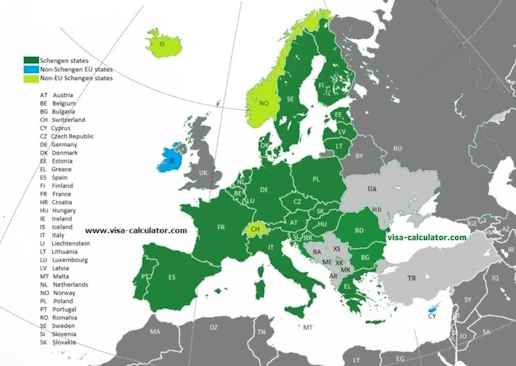
Current interactive map of the Schengen Area and member states.
Current interactive map of the Schengen Area and member states.
Last update: 14-06-2026 09:17
