Schengen Visa Calculator – 90/180 Day Rule Planner


Built for accuracy, transparency, and full alignment with the official Schengen 90/180 day rule.
Visa Calculator is a Schengen calculator that supports both past travel analysis and future trip planning under the 90/180 day rule.
 Used every day by travelers from 115+ countries worldwide.
Please enter your last six months of travel dates to the Schengen countries in chronological order while you plan your next visits.
No data is stored unless you choose to “Save Your Plan”.
Generate your unique Border Guard Mode PDF report. Unlock it with Save Your Plan
Seamless language switching: Once you “calculate” your travel plan, switch between 10 languages without losing your data or results.
Smart Session Migration: Guest travel plans are automatically synced to the user profile upon registration; no need to re-enter your data.
Visa Calculator is a Schengen calculator that supports both past travel analysis and future trip planning under the 90/180 day rule.
Used every day by travelers from 115+ countries worldwide.
Before planning your trip to Europe, there is one essential rule you need to understand: the Schengen 90/180 day rule.
Many travelers misunderstand how it works — often realizing it only after they have already exceeded their allowed stay.
The rule does not reset monthly or yearly.
It works on a rolling 180-day basis, meaning every day you spend in the Schengen Area is continuously counted.
Even a short trip taken months ago can affect your remaining days today.
This is where most mistakes happen.
Many assume their stay resets after leaving the Schengen Area, but in reality, each entry is evaluated individually. A small miscalculation can easily lead to overstaying.
Today, overstays are no longer unnoticed.
With the Entry/Exit System (EES), all travel movements are digitally recorded and automatically checked. Authorities can instantly verify your compliance.
For frequent travelers, planning becomes even more complex.
Each trip affects the next, and overlapping stays can reduce your available days.
Manual calculation is possible — but often unreliable.
That’s why travelers use tools like visa-calculator.com to simulate trips, test scenarios, and clearly see their remaining days before traveling.
Understanding the rule is not just about compliance — it’s about control.
👉 Learn how the 90/180 day rule works and plan your stay with confidenceStaying in the Schengen Area beyond the period you are legally allowed to stay can constitute an immigration violation with consequences for your current and future travel.
Under the Entry/Exit System (EES), entries and exits are digitally recorded, allowing overstays to be automatically identified. Depending on the circumstances and the national rules of the country concerned, an overstay may result in administrative fines, removal procedures, or restrictions on future entry.
Overstay-related decisions can also have consequences for future visa applications or border checks. In some cases, return decisions and entry bans may be recorded in the Schengen Information System (SIS).
Because the applicable procedures, penalties and consequences can vary by country and by the individual circumstances of the case, it is important to understand the rules before reaching the border.
👉 Check the 2026 Country-by-Country Schengen Overstay Fines & Penalties ListPlanning a single trip to the Schengen Area may seem simple. But once multiple trips are involved, things become far more complex than most travelers expect.
The 90/180-day rule does not reset after each trip. It works on a rolling 180-day window, meaning every past stay continues to affect your available days. Even a short visit months ago can still impact your ability to re-enter today.
This is where most mistakes happen. Many assume that leaving the Schengen Area resets their allowance. In reality, each entry is assessed based on all stays within the previous 180 days. Even small overlaps between trips can quickly reduce — or completely use up — your remaining days.
With multiple trips, planning becomes less about counting days and more about understanding timing. The order of your visits, the gaps between them, and the duration of each stay all interact within the same rolling window.
Today, these calculations are strictly enforced. With systems like EES, every entry and exit is recorded and checked automatically.
That’s why manual calculations and assumptions are no longer enough.
Multiple Trips in the Schengen Area: How to Plan Under the 90/180 Day RuleEurope no longer estimates your stay — it calculates it.
Every entry, every exit, every day is recorded, tracked, and continuously evaluated.
This is not just a technical upgrade.
It fundamentally changes how your travel is monitored.
Each time you enter or leave the Schengen Area, your data is digitally stored — including entry and exit dates, travel history, and biometric identifiers.
And most importantly:
Your stay is continuously assessed under the 90/180-day rule.
In practice, this means:
- Every day is tracked
- Every entry is recorded
- Every overstay is visible
Even small miscalculations are no longer overlooked.
Understanding the rule is no longer enough — you must understand how it is enforced.
👉 Learn how the Entry/Exit System (EES) works and what it means for your travelTravel to Europe no longer begins at the border - it begins before you even leave your country.
Your trip is assessed in advance.
Your entry may be decided before you arrive.
ETIAS is a mandatory pre-travel authorisation for visa-free travelers entering the Schengen Area. It is not a visa, but it is no longer optional.
Before departure, you must complete a digital application. Your personal, travel and security data are automatically checked across European systems.
In most cases, approval takes minutes.
But some applications may be delayed or refused before you reach the border.
This is the shift:
Entry decisions no longer start at the border. They start before your journey.


Most travelers don’t break the Schengen 90/180 rule on purpose — they break it because they misunderstand how it is calculated.
The rule seems simple, but it works on a rolling 180-day basis, where every past trip still affects your future travel.
This is where mistakes happen.
Using a Schengen calculator is simple: select your dates, add your trips, and click “calculate.”
Behind that simple action, the system analyzes your entire 180-day travel history instantly.
Instead of guessing, you can:
- see your remaining days instantly
- find your earliest safe re-entry date
- simulate future trips with confidence
A calculator is not just a counter — it is a planning system.
👉 Learn step-by-step how to use the Schengen Visa Calculator, with real examples and practical scenariosMany travelers think the European Union and the Schengen Area are the same — they are not.
Schengen is about border control.
The EU is about political and economic cooperation.
For travelers, this difference is critical:
Your stay is calculated under Schengen rules — not EU membership.
The 90/180-day rule applies to the entire Schengen Area as one zone. Moving between countries does not reset your stay.
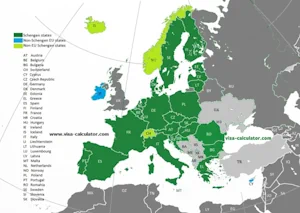
However, not all EU countries are in Schengen, and not all Schengen countries are in the EU. This difference can create opportunities — or serious mistakes if misunderstood.
Many travelers assume their stay resets when crossing borders within Europe. It does not.
European Union and Schengen Area: Countries and DifferencesMost Schengen calculators simply count past days.
visa-calculator.com is built on a rolling 180-day calculation engine, combined with forward-entry simulations and stay optimization logic — helping you plan intelligently within the 90/180 day rule.
Unlike basic tools, it is designed as a planning system, not just a counter. You can simulate future entries, test different scenarios, and optimize your stay duration with clarity.
Our algorithm is based on Regulation (EU) 2016/399 and reflects how the rule is applied in real border control situations. This ensures calculations are not only mathematically correct, but also aligned with real-world enforcement.
Instead of relying on static date counting, the system dynamically evaluates each stay within a moving 180-day window. It accounts for overlapping trips, partial stays, and future travel plans — factors often missed by simpler tools.
This approach gives you full visibility over your travel timeline. By understanding how each entry affects the next, you can avoid unintended overstays and plan with confidence.
It also supports better decision-making — whether adjusting travel dates, testing itineraries, or checking eligibility for re-entry.
How It Works: Inside the 90/180 Day Rule Planning EngineUnderstanding Schengen travel is not just about knowing the rules — it is about knowing how those rules apply in real situations.
Most travelers believe they are compliant. Many only discover their mistake when it is already too late.
A few miscalculated days, an overlooked trip, or a misunderstanding of the rolling 180-day rule can lead to serious consequences — from denied entry to future travel complications.
Today, these mistakes are no longer invisible. With systems like EES, every entry and exit is digitally recorded and evaluated with precision.
That is why relying on assumptions is risky.
These guides are designed to give you clarity — not confusion.
You will learn how the 90/180-day rule really works, how to calculate your remaining days correctly, and how to plan multiple trips without risking overstays.
👉 Explore all Schengen Travel Guides and take control of your travel planningFrequently Asked Questions About Schengen 90/180 Day Rule
You can add Visa Calculator to your phone’s home screen for quick, one-tap access to your Schengen travel planner.
On iPhone or iPad (Safari):
- 1. Open visa-calculator.com in Safari.
- 2. Tap the Share button.
- 3. Select Add to Home Screen.
- 4. Tap Add.
On Android (Chrome):
- 1. Open visa-calculator.com in Chrome.
- 2. Tap the three-dot menu.
- 3. Select Install app or Add to Home screen, depending on your device and browser.
- 4. Follow the on-screen instructions.
Once added, the Visa Calculator icon will appear on your home screen, allowing you to open the calculator quickly whenever you need it.
The exact menu wording may vary depending on your device and browser version.
Answer:
Creating a member account on Visa Calculator is simple and free.
- 1. Click Save Your Plan on the homepage, or select Haven’t registered yet? on the Member Login page.
- 2. Enter your email address twice, choose a password, confirm it, and accept the Terms and Conditions.
- 3. Click Sign Up. Your member account is created immediately, with no additional email confirmation required.
- 4. Enter your travel dates and click Calculate & Save Your Plan. Your travel data will be synchronized with your account and saved automatically.
Once your plans are saved, you can return to them whenever you need and download your travel reports in Standard Mode or Border Guard Mode.
Overstaying is a recorded violation and can lead to serious consequences. These may include financial penalties, forced departure, or entry bans that can last for several years. Even a short overstay can affect your future travel history. With the Entry/Exit System (EES), all entries and exits are digitally recorded, making violations automatically detectable.
The 90/180 rule does not reset on a fixed date. Instead, it is continuously calculated by looking back at the previous 180 days from any given day of your stay. If you have already used 90 days within that period, you are no longer allowed to remain in the Schengen Area. This rolling system makes manual calculations difficult and prone to error.
The rule does not reset on a specific day like January 1st. Your available days are recalculated every single day based on your travel history over the previous 180 days. As older days fall outside the 180-day window, new days gradually become available again.
Important Notice for Travellers: Please ensure that your passport meets the Schengen Border Code validity requirements. It must have been issued within the previous 10 years and must remain valid for at least 3 months after your intended date of departure from the Member States.
Reminder: Visa Calculator is a helping tool only, it does not constitute a right to stay for a period resulting from its calculation. It is always for the Member States’ competent authorities (in particular for the border guards) to implement the provisions and make a decision on the length of the authorised stay or on the overstay.
As a result of calculations if you have noticed any technical inconvenience or error in the website, and/or your valuable suggestions on developments your reports to info [@] visa-calculator.com will be appreciated.

